The built-in Administrator account is hidden from Welcome Screen when a user account with Administrator privileges exists and enabled. In Windows XP Home Edition, you can login as built-in Administrator in Safe Mode only. For XP Professional, press CTRL + ALT + DEL twice at the Welcome Screen and input your Administrator password in the classic logon window that appears.
To have the Administrator account displayed in the Welcome Screen, try one of these methods:
Method 1: Using TweakUI Power Toy for Windows XP
Download TweakUI from here:
v2.00 for Windows XP | v2.10 for XP SP1 and above
Open TweakUI and click "Logon" option in the left pane. Put a checkmark against the option "Show Administrator viagra cost on Welcome Screen". Click OK to close TweakUI. Logoff and see if Welcome Screen lists Administrator login. Changes are immediate and you can use the Winkey + L to switch back to Welcome Screen to see Administrator account is listed.
Use this procedure to hide/unhide any user account from the Welcome Screen. Please remember, you can still login to a hidden account using CTRL+ALT+DEL classic logon method, but cannot Fast User Switch to a hidden user account.
Method 2 – Manual registry edit
HKEY_LOCAL_MACHINE \ SOFTWARE \ Microsoft \ Windows NT \ CurrentVersion \ Winlogon \ SpecialAccounts \ UserList
-
-
Create a new DWORD Value named Administrator
-
Double-click Administrator, and set 1 as its data
-
Exit the Registry Editor.
For Windows XP Home Edition
While you can configure Windows XP Home Edition to show Administrator account in the Welcome Screen, you cannot login as Administrator in Normal mode. Visit the following link for more information:
Error Message: Unable to Log You on Because of an Account Restriction
By default, Windows 7 does not have the Quick Launch toolbar that most Windows users are familiar with. viagra commercial If you wish to keep using this form of navigation, or if you’ve upgraded your computer to Windows 7 and want to use your old Quick Launch Bar, you can enable it by following these steps.
1. Right-click on the Taskbar.
2. Mouseover Toolbars and select New toolbar.

3. In the Folder textbox, input the following:
%SystemDrive%\Users\%username%\AppData\Roaming\Microsoft\Internet Explorer\Quick Launch
Click on the Select Folder button.
The Quick Launch Bar will appear. Unlock the Taskbar by right-clicking on the taskbar and unchecking Lock Taskbar. Move the Quick Launch Bar to the desired location on the taskbar and then relock the taskbar.

If you like keeping a clean desktop, then even having the Recycle Bin icon sitting there can be annoying. By placing a shortcut on your taskbar, you will have easy access while keeping it off of your clean desktop. This recipe adds the shortcut to the Taskbar instead of pinning it to the Windows Explorer icon.
1. Right-click on your Desktop.
2. When the context menu appears, mouseover New and select Shortcut.
3. The Create Shortcut window will appear, input the following into the Type the location of the item textbox:
%SystemRoot%\explorer.exe shell:RecycleBinFolder
4. Click the Next button.
5. Input a name for the shortcut, such as Recycle Bin or Trash.
6. Click the Finish button.
7. The shortcut will appear on the Desktop, however, you will need to change the icon. Right-click the newly created shortcut and select Properties.
8. Click the Change Icon button.
9. Input the following in the Look for icons in this file textbox:
%SystemRoot%\system32\imageres.dll
10. Press Enter on your keyboard.
11. Select the Recycle Bin icon. Click the OK button.

viagra cheap buy
12. Now that your icon looks good, move the shortcut to your Documents library (or some other location).
13. Right-click the shortcut and select Pin to Taskbar.
14. The icon will now be on your Taskbar. Move it to the desired location.
Due to the new design behavior guideline for Windows Taskbar on Windows 7, more and more software application has now making its icon to locate and stick at Windows 7 Taskbar when minimized, instead of minimizing to system tray (notification area). The most common example in Windows Live Messenger, and now Skype 4.2 (download Skype 4.2 Beta) follows the footstep.
In Skype 4.2 or any newer versions, Skype will be minimized to Taskbar, as an icon or button, when the Skype main window is closed. In previous versions, such as Skype viagra canadian 4.1, 4.0 and 3.0, Skype is typically minimized to system tray, which now known as notification area, right beside the clock on Windows Taskbar when the main window is closed.
Leaving the Skype program running on Windows Taskbar is not very useful to many users, especially notifications alert will pop up informing user when there is new incoming call, instant message (IM), files, contacts, events and etc. The Taskbar icon or button is prone to mistakenly or accidentally click and activate, and the Skype window is also subjected to rotation when user jumping around tasks with Alt+Tab or Win+Tab keyboard shortcuts.
In order to make Skype minimize and hide its icon into notification area or system tray when minimized, users can use the same trick to minimize Windows Live Messenger MSN Messenger to system tray in Windows 7. Here’s how to minimize Skype to notification tray on Windows 7.
Updated Skype Built-In Method
- In Skype, go to Tools -> Options.
- Then, click on Advanced tab to go to Advanced settings.
- Uncheck and untick the Keep Skype in the taskbar while I’m signed in option.
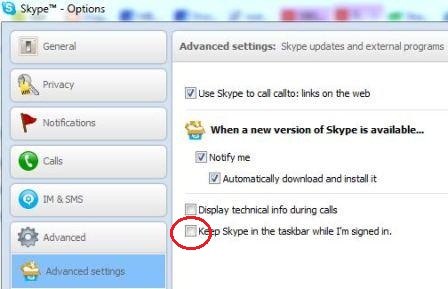
- Click Save button, and the Skype button or icon will be removed from Taskbar on minimize.
Note: You won’t see the option if the Skype is in compatibility mode.
Compatibility Mode Method
-
Exit or quit from Skype program.
-
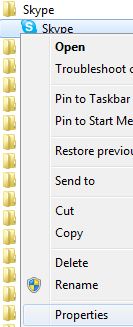
Right click on Skype icon on Desktop or Skype shortcut in Start Menu, and select Properties.
-
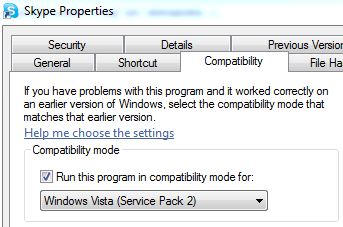
Go to Compatibility tab.
-
Under “Compatibility Mode’ section, check and tick the checkbox for Run this program in compatibility mode for: option.
-
In the below drop-down box, select Windows Vista (Service Pack 2).
-
Click OK.
-
Start the Skype program, and now it should minimize to system tray.

Information
If one or more of your icons are not displaying correctly, or that your icon cache is corrupted, then you might consider rebuilding the icon cache to reset and reload the icon images into the icon cache.

Note
This will not help with any of the following icon issues:
- A shortcut's icon that is not displayed properly due to the source of the shortcut being moved or deleted. You may need to recreate a new shortcut directly from the source (ex: program's exe) file to replace it instead.
- All icons for a specific file extension display the wrong icon. This may be do to setting the wrong association for what program to open the file extension instead. You can restore the default file extension's associations to fix this icon instead.
OPTION ONE
Automatically Rebuild the Icon Cache
NOTE: Thank you to Chris Sanders (aka Zidane24) for this updated BAT file version.
1. Click on the download button below to download the file below.
Rebuild_Icon_Cache.bat
viagra canada online />

2. Save the file to your desktop, and run it.
3. Click on Run when prompted.
4. Follow the instructions in the command prompt to rebuild the Icon Cache
OPTION TWO
To Manually Rebuild the Icon Cache using the Command Prompt
1. Close and save anything that you are working on. This command will kill explorer and restart the computer when completed.
2. Open the Start Menu, and type cmd in the search box and press enter.
3. In the command prompt, Copy and Paste each command line below exactly as is and press enter after each command.
- taskkill /IM explorer.exe /F
- CD /d %userprofile%\AppData\Local
- DEL IconCache.db /a
- shutdown /r
4. The IconCache.db file has now been rebuilt.